Alfred Ernest Ramsey was born on 22 January 1920 at 6 Parrish Cottages, Halbutt Street, Dagenham. The third of five children born to Herbert and Florence Ramsey, he would rise from a humble cottage lacking electricity and hot running water to become the only England manager ever to win the World Cup.
Childhood on Halbutt Street
Parrish Cottages, where Ramsey spent his earliest years, sat in a part of Dagenham that remained largely untouched by the rapid urbanisation transforming the surrounding area. When Ramsey was born, Dagenham was still an agrarian village roughly ten miles east of central London. His father worked a smallholding, kept pigs, and drove a horse-drawn dustcart to support the family.
The cottage itself was basic by modern standards: no hot running water, no electricity until the 1950s, and an outdoor toilet. A contemporary, Phil Cairns, later described Parrish Cottages as "little more than a wooden hut." Yet it was here that Ramsey's love affair with football began, playing ball games with his brothers behind the cottage.
School Days at Becontree Heath
At age five, Ramsey began attending Becontree Heath School, a modest institution with a roll of approximately 200 pupils covering ages four to fourteen. The journey from Parrish Cottages to school took two hours on foot, a distance Ramsey and his brothers covered while passing a football between them.
His talent was evident early. Ramsey was selected to represent the school football team at age seven, playing inside-left alongside his brother Len at inside-right. By age nine, he had been appointed captain, and he soon transitioned to centre-half, the position that would define his playing career.
The Co-op Apprentice
After leaving school, Ramsey sought work at the newly opened Ford Dagenham plant, which had begun operations in 1931. When that proved unsuccessful, he became a grocery apprentice at the local Co-operative Society, delivering groceries by bicycle around the borough from 1934 to 1936.
The job demanded Thursday afternoons off, which led Ramsey to join Five Elms, a local amateur football club, for the 1936-37 season. It was during his time with Five Elms that Portsmouth scout Ned Liddell spotted him in the 1937-38 season, setting in motion a professional career that would span playing and managerial triumphs.
From Dagenham to Wembley
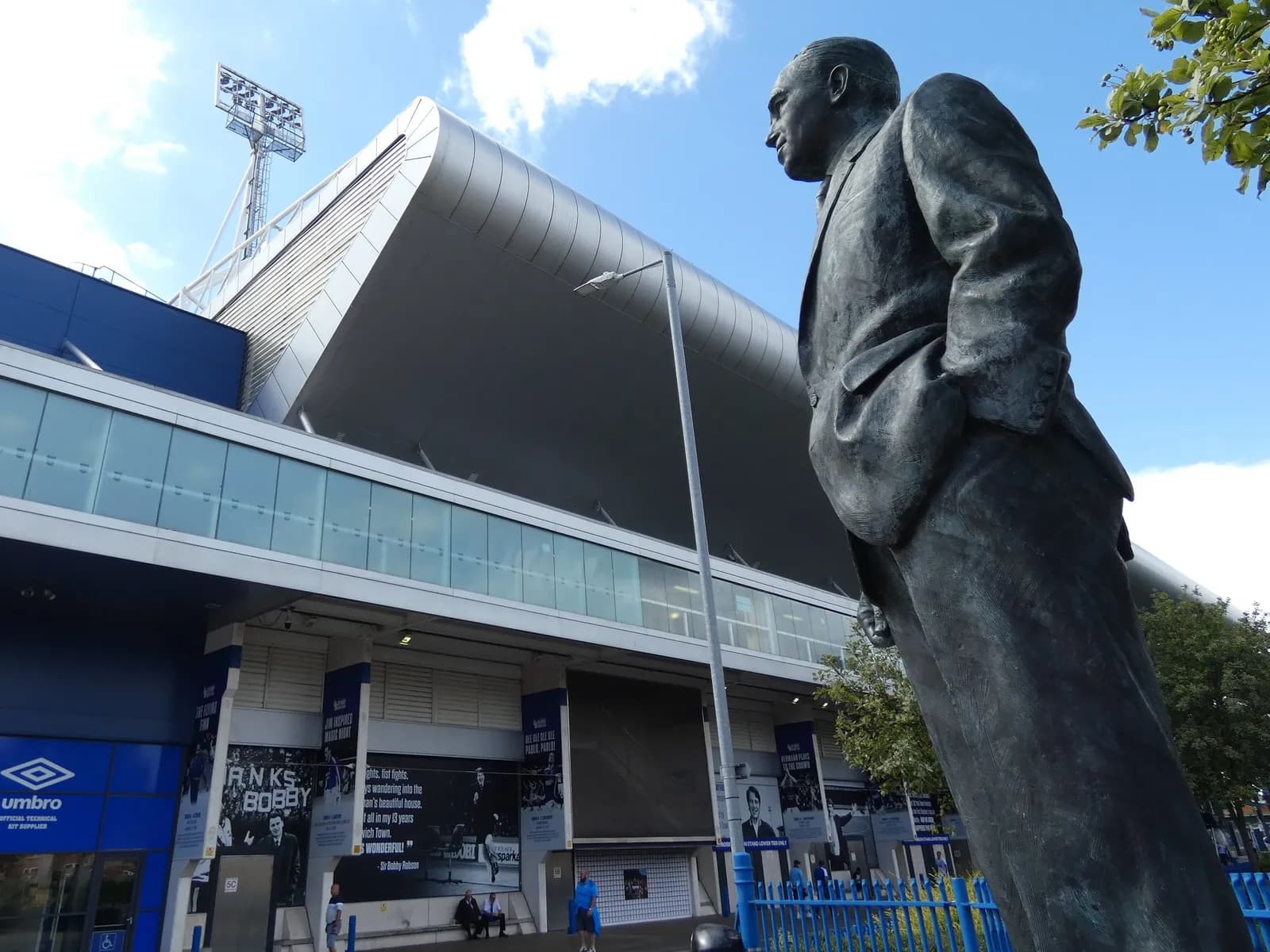
Ramsey's playing career took him to Southampton and then Tottenham Hotspur, where he made 226 league appearances and earned 32 England caps between 1948 and 1953. His managerial career began at Ipswich Town in 1955, where he achieved remarkable success: promotion from the Third Division South in 1956-57, the Second Division title in 1960-61, and the League Championship in 1961-62.
In 1963, Ramsey was appointed England manager. He made an immediate impact, introducing tactical innovations that defied conventional wisdom. His "Wingless Wonders" formation, a narrow 4-4-2 system, abandoned traditional wing play in favour of compact midfield control.
The 1966 Triumph
On 30 July 1966, Ramsey led England to victory in the World Cup final at Wembley Stadium. England defeated West Germany 4-2 after extra time, with Geoff Hurst scoring a hat-trick and Martin Peters adding the other goal before 96,924 spectators. Ramsey became the first manager to win the World Cup on home soil, and only the second to achieve the feat for a host nation.
Recognition followed swiftly. Ramsey was knighted in the 1967 New Year Honours, becoming Sir Alf Ramsey. He remains, to this day, the only England manager to win a major international tournament.
The General's Legacy
Ramsey died on 28 April 1999 in Ipswich, aged 79. His legacy endures through the statue erected at Wembley Stadium in 2009 and his dual induction into the English Football Hall of Fame, both as a manager in 2002 and as a player in 2010.
For Dagenham, Ramsey represents a remarkable thread of local history. The boy who walked two hours to school along Halbutt Street, who delivered groceries by bicycle for the Co-op, and who played amateur football for Five Elms before being discovered on a Portsmouth scout's notepad, achieved what no England manager has managed before or since.
Though Parrish Cottages have long since disappeared, and no blue plaque marks the site of his birth, Ramsey's story remains woven into the fabric of the borough: a working-class Dagenham boy who conquered world football.